

How do UK number plates work?
Several different number plate systems existed prior to the current one.
From 1963 to 1982 the age identifier was the last character on the plate, this changed in 1983 when the age identifier was a single letter at the start of the plate. Number plates only changed once a year between 1983 to 2001. In 2001 the current system was introduced.
A standard UK number plate comprises of:
- Two letters that represent the region the car was registered in (DVLA memory tag)
- Two numbers that represent when the car was registered (Age identifier)
- A set of three randomly generated letters
Number plates issued from March to September contain two numbers representing the year, while the plates issued from September plates are the year plus 50. You can see how this works in the table below:
|
Year of car registration |
Plate from March-onwards |
Plate from September-onwards |
|
2001 |
01 |
51 |
|
2010 |
10 |
60 |
|
2020 |
20 |
70 |
|
2023 |
23 |
73 |
|
2024 |
24 |
74 |
Under the current system, in 2030 from the 1st March 2030, we will have 30-plate EVs and then 80-plate EVs from 1st September.
Rules for number plates
There are strict rules concerning the registration plates on your vehicles.
The number plates on your vehicle must:
- be made from a reflective material
- display black characters on a white background (front plate)
- display black characters on a yellow background (rear plate)
- not have a background pattern
- be marked to show who supplied the number plate
- be marked with a British Standard number - this is ‘BS AU 145e’ for plates fitted after 1 September 2021
- the characters must not be removable or reflective. If your number plates were fitted after 1 September 2021, they must also be a single shade of black.
The characters on a number plate need to be a certain height and size:
- characters must be 79mm tall
- characters (except the number 1 or letter I) must be 50mm wide
- the character stroke (the thickness of the black print) must be 14mm
- the space between characters must be 11mm
- the space between the age identifier and the random letters must be 33mm
- the margins at the top, bottom and side of the plate must be 11mm
- vertical space between the age identifier and the random letters must be 19mm
At the time of writing, you could be fined up to £1,000 and your vehicle will fail its MOT test if you drive with incorrectly displayed number plates.
What is a private number plate?
Private number plates, also known as personalised plates, are number plates that are bought based on the specific characters they contain. Personalised plates can be bought directly from the Driver and Vehicle Licensing Agency or, if they’re already in circulation, can be purchased from auctions, traders or private individuals.
Personalised number plates can represent anything from the driver’s or company’s name to a meaningful date, or any other word or words, as long as they are not deemed offensive.
A personalised plate can make a vehicle look older than it is (e.g. XX54 plate on a 2020 EV), you cannot have a personalised plate on a vehicle that implies it is newer than it is (e.g. XX73 on a 2020 EV).
It is illegal to alter the spacing of personalised number plates – even those with fewer than seven characters must adhere to the strict spacing and font rules.
What does the green flash on a number plate mean?
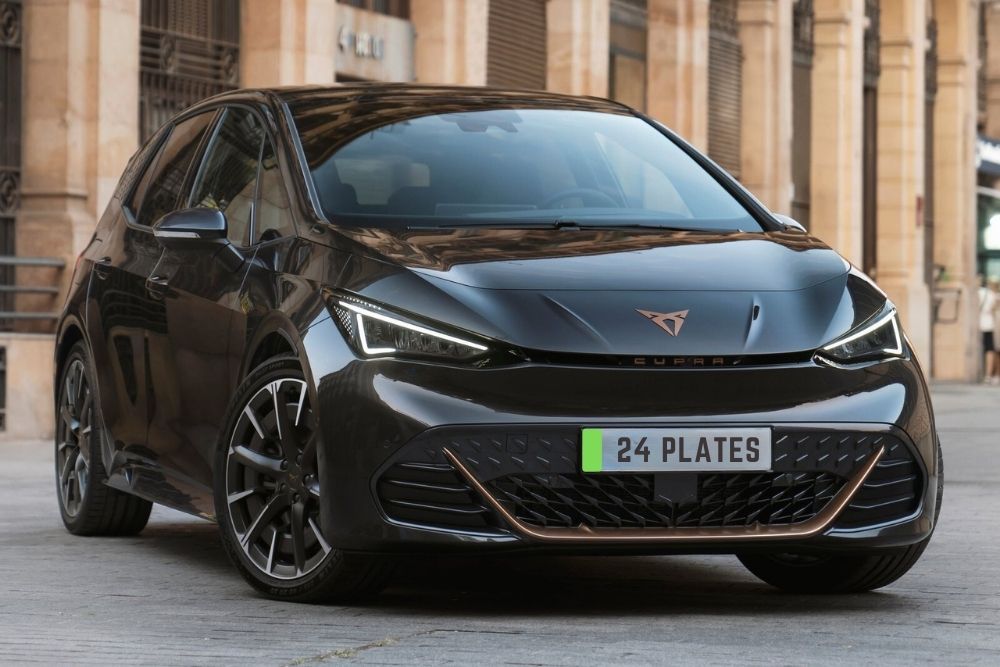
If you buy a new fully electric car or van it is likely that your vehicle will be fitted with a ‘green number plate’. These have a green flash on the left-hand side of the reg plate to indicate the EVs zero tailpipe emission.
Where can I get number plates made?
If you need a replacement for your current numberplate, a spare for your trailer or caravan or you have brought a private plate and would like to assign it to your vehicle, you should get number plates made up by registered suppliers, and you can find a list of these on the Government’s official website.
The supplier will need to see original documents that:
- prove your name and address.
- Show you’re allowed to use the registration number (such as your Logbook (V5C) new keeper slip, certificate of entitlement (V750) / retention document (V778))