

Research from Zapmap and the RAC shows the total number of supermarkets offering EV charging points increased by 59% last year, from 1,015 stores in 2022 to 1,616 in 2023, accounting for 13% of all 12,839 UK supermarkets (including those without parking facilities).
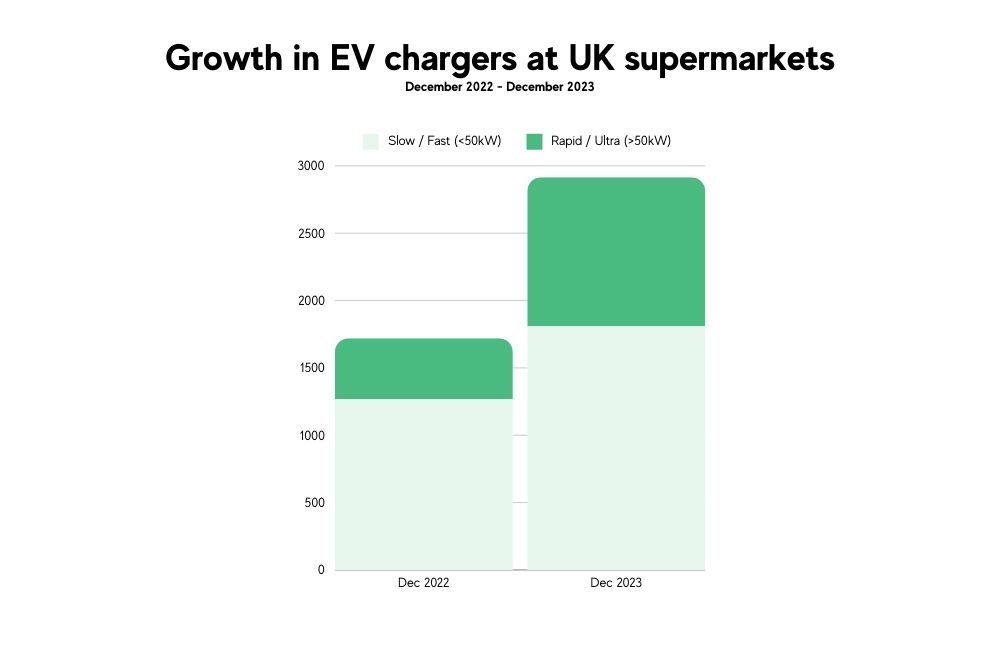
The installation of chargers also increased by 69%, as stores added 1,195 new charging devices in 2023, raising the total from 1,721 in 2022 to 2,916 by the end of 2023.
Among these, 1,107 units were rapid or ultra-rapid chargers, marking a notable 145% increase from 2022, enabling over half (55%) of all supermarket EV locations to offer higher-powered charging.
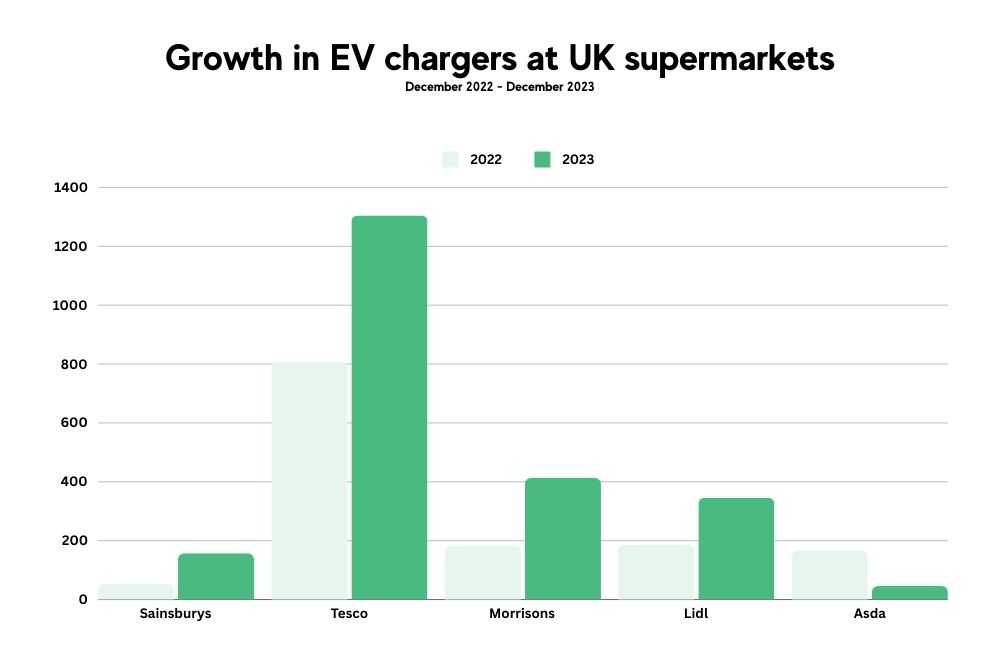
Sainsbury’s saw substantial growth year-on-year due to its Smart Charge ultra-rapid network, nearly tripling its total number of chargers by adding 104 new devices in 2023.
Tesco maintained its position as the largest supermarket charging network with 1,305 devices across 4,859 stores, adding 497 chargers last year. Despite a 50% year-on-year increase in the number of Tesco sites with charging facilities, only 10% (132) of its 1,305 devices were rapid or ultra-rapid. The number of free EV charging points at Tesco locations decreased, with Pod Point’s 7kW and 22kW chargers at Tesco sites now incurring a cost.
Morrisons and Lidl lead in the proportion of chargers per estate and the number of rapid chargers installed. Morrisons had 413 devices at 69% (344) of its 497 stores, 99% (342) of which had rapid devices. Lidl also installed 346 chargers at nearly a third (30%) of its 960 stores in 2023, with 91% (258) of the 285 EV locations offering rapid charging facilities.
On the other hand, Asda removed a significant portion of its devices after its contract with bp pulse ended, decreasing by 72% from 165 in 2022 to just 46 in place through 2023.