One of the most common sources of anxiety surrounding switching to an EV is charging on the public network. To help you feel confident with transitioning to an EV and using a public charging point for the first time, we have put together this guide to answers some of our most frequently asked questions about public charging.
What is the public charging network?
The UK’s public charging network provides charging facilities for EV drivers who need to top up enroute, or whilst they are away from where they would usually charge their EV.
At the end of March 2024, there were 59,590 electric vehicle charging points, across 32,322 charging stations in the UK, offering a mix of slow, fast and rapid charging options.
With the UK's public electric vehicle charging network expanding rapidly, there are a number of EV charging providers across the country. Some offer national coverage while others provide charging in a specific region.
What are the different types of EV chargers?
Depending on if you are topping up enroute, at the end of a ‘leg’ during a trip / when you arrive at your main destination for the day, there are several types of chargers available to EV drivers.
|
Slow charger (AC) |
Slow chargers typically perform at 3kW. This is associated with charging via a 3-pin plug |
|
Fast Charger (AC) |
The most common type of charger provides speeds between 7kW and 22 kW AC. These are mostly home charge points but also can be found at public charging networks in areas where drivers will leave their car for a significant amount of time, such as a shopping centre. |
|
Rapid Charger (DC)* |
Are typically capable of charging at 50kW-100 kW. These charging stations are often located at service stations. |
|
Ultra Rapid Charger (DC)* |
These types of chargers are even faster than rapid chargers, most are rated at a minimum of 100 kW, with some providing up to 350 kW. |
*DC Chargers restrict charging speeds once the vehicle reaches 80% to protect the battery
How long will it take to charge my car?
Your charging time will depend on several factors including:
- Size of Battery (Battery Capacity) measured in kWh, the larger your EVs battery, the longer it might take to charge, as larger batteries tend to provide a higher electric range.
- State of battery (empty or half full etc.) if you are charging from empty, it will take longer to charge than it would if you were topping up.
- Maximum Charging Rate of your EV: You can only charge a vehicle’s battery at the maximum charge rate the vehicle can accept. If your vehicle’s max charge rate is 50kW, your EV will not charge any faster by using a 200kW chargepoint.
- Max charging rate of charge point: The time it takes to charge is also limited by the max charging rate of the chargepoint you are using. Even if your vehicle can charge at 200kW, it will only charge at 50kW on a 50kW chargepoint.
The time it takes to charge an EV, is often advertised by the manufacture. At Lease Electric, we display this information for each vehicle under 'Technical Data’. However, using this calculation will give you an estimated charging time (0-100%) = Battery Capacity (kWh) / Charging Speed (kW).
Most EVs have controls, which allow you to adjust the charging percentage. Setting this to 80%, especially when at a public charging station will increase charging efficiency and reduce cost. Find out more about charging to 80% by clicking here.
Example:
VW ID.3 (150kW Pro 58kWh 5dr Auto)
To charge this EV from 20-80% will require approximately 35kWh (60% of the overall battery capacity). At 80% you will receive up to 212 miles of electric range (WLTP).
- 35kWh / 50kW = 42 minutes
- 35kWh / 100kW = 21 minutes
To charge from 0-100% you will require 58kWh. At 100% you can expect an electric range of up to 266 miles (WLTP).
- 58kWh / 50kW = 1hour 10 minutes
- 58kWh /100kW = 35 minutes
How do I find my nearest EV charging point?
We always recommend planning your journeys, factoring in a pit stop to top up your EV and take a break from driving, especially on longer journey. Preplanning can help to reduce charging anxiety. Just like when you are searching for a nearby fuel station, there are a few ways to find your nearest charging point.
- Dedicated websites and apps such as ZapMap, PodPoint, GridServe or Co Charge. Zapmap shares a charging map showing available chargers, costs, supplier and payment information. They list 95% of the UKs available charging points, alongside various points available in both France and Germany.
- Using Google Maps search ‘EV chargers near me’ - whilst this isn’t as comprehensive a guide as dedicated platforms such as Zap Maps, Google Maps will show chargers that have been listed with them:
- Some EVs use their SatNav systems to flag up nearby chargers, or even factor in a charging stop for you if you are using the SatNav.
Things to consider when searching for a charging point
- Location of charger - is it enroute or will it mean taking a large detour?
- What type of charger is it? - Does the charger only provide AC charging of 7kW, or can you connect to a DC charger and benefit from rapid charging?
- Which connectors are available? - Most UK charging stations provide tethered CCS / CHAdeMO connectors, but some points might require you to use your own cable.
- How will you pay? Do you have the right account, app or RFID card to pay for the charging, or can you use your bank card?
This can feel overwhelming to those of us who are used to pulling into a petrol station, filling up, paying at the checkout and getting back on the road. But thanks to apps such as ZapMap, you can find this information in one place. ZapMap provides a breakdown of:
- Network Provider
- Devices available, charging speeds and connectors
- Payment information
- Cost per kWh
- Parking charges (if applicable)
- Opening times
- Location address and URL
- Reviews from other users.
How do I use an electric car charging point?
Once you’re at the charger, park in the bay with your charging port close to the charging point and turn off your EV. Then follow the instructions on the charger or your chosen App. It is often as simple as:
- Tap your debit, credit or charging card, or activate charging on your app (i most cases, the provider will take a deposit of between £25 and £40 and then refund or increase the payment so that you are charged the final amount).
- Plug your EV into the charging point
- Charging begins.
Once charging begins, you can lock your EV and leave it to charge.
How do I stop a charge at an EV charge point?
If your EV has charged to the set percentage, the charge will automatically stop. However, if you have returned to your EV and you are happy with the charging percentage and range available, you can stop charging.
In most cases, stopping a charge is as simple as following the instructions on the charge point screen, or in the app you’ve used. Many EVs will also provide you with an option to stop your current charge, for some this is done within their app, others display charging information on the infotainment screen.
Once charging has stopped, follow the instructions on the charge point screen, unplug the connector and safely drive away.
All charge points are fitted with emergency stop buttons. When pressed, the network provider will be notified and the charge point will be immediately switched offline. The point will remain unusable until the provider reactivates it following safety checks.
How much does it cost to charge your EV at a public charging station?
All public EV charging points charge different amounts, varying between 34p - 90p per kWh. Over the next few years, we suspect that these prices will be displayed, roadside, like how Petrol and Diesel prices are advertised at fuel station forecourts.
However, for now, pricing can be found on the charge point providers website, dedicated EV charging apps such as ZapMap or PodPoint or displayed on the charging point screens and signs.
Example:
VW ID.3 (150kW Pro 58kWh 5dr Auto)
To charge this EV from 20-80% will require approximately 35kWh (60% of the overall battery capacity). At 80% you will receive up to 212 miles of electric range (WLTP).
- 35kWh x 34p = £11.90
- 35kWh x 50p = £17.50
- 35kWh x 90p = £31.50
To charge from 0-100% you will require 58kWh. At 100% you can expect an electric range of up to 266 miles (WLTP).
- 58kWh x 34p = £19.72
- 58kWh x 50p = £29
- 58kWh x 90p = £52.20
As of March 2024, the price for a rapid charge in the UK was around 77.38p per kWh.
Using the above example, a 20-80% charge would cost an average of £27.08 at a rapid charging station.
How do I pay at an EV charging station?
As we’ve previously mentioned, there are various ways to pay for EV charging on the public network.
- Tap your bank card or use Apple / Google Pay - they will often hold a deposit of between £25 and £40 and then refund you (or increase it) so that you are charged the actual amount.
- Tap your charging card - some charging providers offer charging cards (RFID) that you can tap at specific chargers and receive monthly bills. Many employers who provide EVs as company cars use charging cards in the same way as they would have previously used fuel cards.
- Pay via an app - When you sign up to the app, you are likely to be asked for payment information, your account will then be charged after use.
How accessible is public charging?
Launched in October 2022, the accessibility standard from BSI provides detailed requirements and recommendations for accessible EV charging. Co-sponsored by Motability and the Office for Zero Emission Vehicles, it covers the design and placement of charging points, including the location spacing and surrounding environment, as well as the information, signals and indicators to be provided.
The full title for the standard is: PAS 1899:2022 Electric Vehicles - Accessible Charging - Specification.
Whilst PAS 1899:2022 is not a legal requirement, adherence is crucial for ensuring accessible and inclusive EV charging facilities and providers that fail to comply may find it challenging to defend against legal action on the grounds disability discrimination.
Not only does adhering to this standard ensure accessibility, but also promotes saftey through the recommendation of lighting and security cameras.
Can someone unplug my electric car?
It is becoming more frequent that to disconnect an EV from a charging station, the vehicle must first be unlocked. Locking mechanisms are present in the car-side Type 2 sockets and some Type 1 sockets. Nevertheless, some Type 1 vehicles can still be disconnected by a third party.
Although it is not illegal for someone to unplug your electric car without permission, it is considered poor EV charging etiquette.
What do I do if an EV charge point isn’t working?
Whilst apps such as ZapMap and PodPoint provide guidance on availability of chargers, and reviews from previous customers (who are likely to mention if a charge was unsuccessful). If you have plugged your EV in and followed all the instructions on the charger or app, and something still doesn’t seem to be working, contact the number on the charge point. If initial guidance does not rectify the issue, you will be supported to find another local charge point.
What is community charging?
Community charging is similar to Airbnb, but for EV chargers.
Most drivers with a home electric car charge point only use their home charger overnight. When they are not using it, the host can list it as available to book by other EV drivers, who pay a fee to use it.
Apps such as Co Charger allow you to both rent our your charger, and find a local charger. For many this is convenient, and becoming increasingly popular when working away from home, or on holiday - when you plan to leave your vehicle for a few hours at a time.
What will public charging look like in the future?
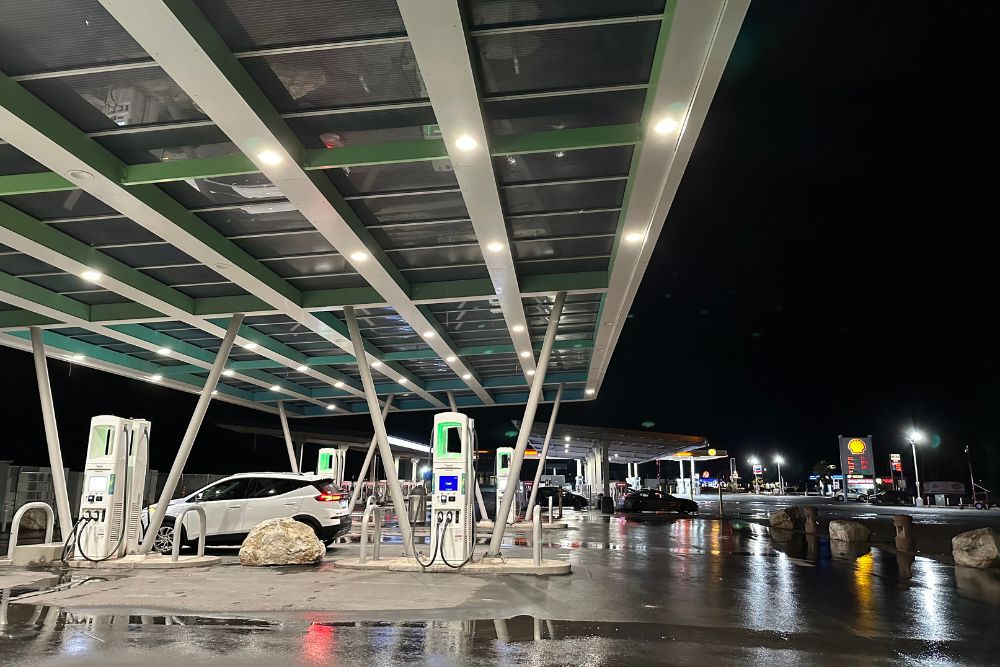
As the UKs charging infrastructure continues to grow, new charging points are popping up everywhere. From motor way service stations to areas of outstanding natural beauty, tourist attractions and residential streets.
In the future, we expect most charging stations that form part of the UKs public network, will adhere to standards such as PAS 1899:2022.
Similar to motorway service stations, providers, such as GRIDSERVE are developing EV charging forecourts. That provide drivers with access to toilets showers, cafes, takeaway food and restaurants, shops even ‘hot desk’ office space for those working on the move.
GRIDSERVE Electric Forecourts, can be found at Braintree, Norwich and London Gatwick. With 12 others under construction or with planning permission in place.