
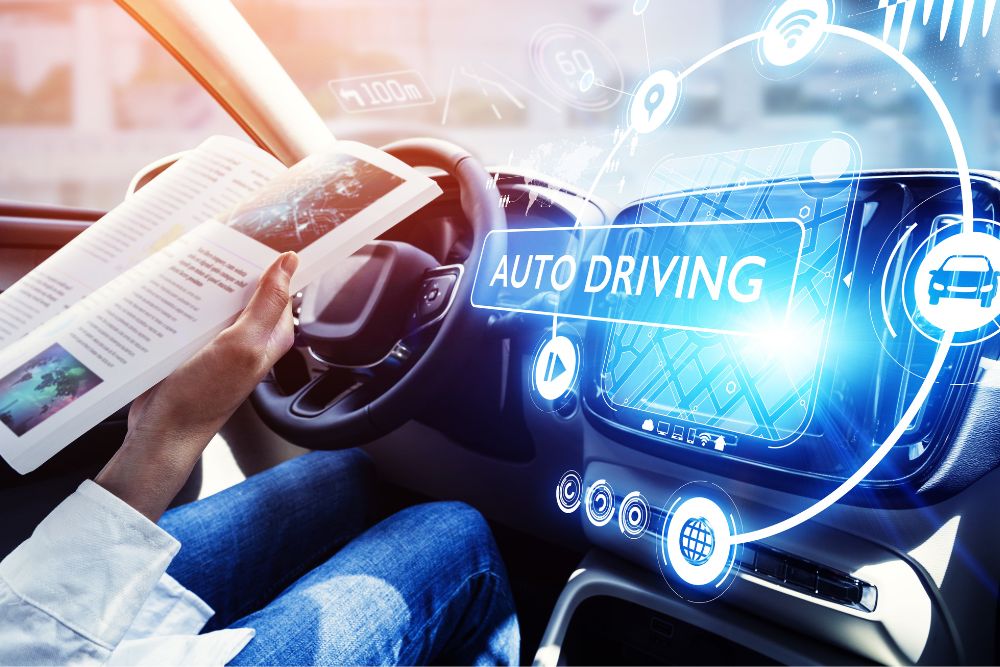
Self-driving vehicles may be navigating UK roads within the next two years, following the enactment of the Government's Automated Vehicles (AV) Act.
As of 20th May 2024, the act stipulates that motorists are not accountable for their vehicle's behaviour in self-driving mode. Responsibility will fall on manufacturers, insurers, and software developers if issues arise, as the driver is deemed merely a 'user in charge.' Additionally, the legislation mandates rigorous safety evaluations for new autonomous vehicles to ensure they match the safety level of "careful and competent human drivers." The Government anticipates that this advancement will considerably reduce the risk of human error, which is responsible for 88% of road collisions.
Transport Secretary, Mark Harper, commented: “Britain stands at the threshold of an automotive revolution and this new law is a milestone moment for our self-driving industry, which has the potential to change the way we travel forever."
“While this doesn’t take away people’s ability to choose to drive themselves, our landmark legislation means self-driving vehicles can be rolled out on British roads as soon as 2026, in a real boost to both safety and our economy.”
The Government claims that the AV Act represents "the most comprehensive legal framework of its kind worldwide," with the potential to catalyse a new industry valued at up to £42 billion and generate 38,000 skilled jobs by 2035.
As this new legislation paves the way for self-driving vehicles in the UK, we've explained the current levels of vehicle automation below.
What is Vehicle Automation?
Vehicle automation refers to the use of technology to control various functions of a vehicle without human intervention. This technology is designed to improve safety, efficiency, and convenience for drivers and passengers.
There are different levels of vehicle automation, ranging from basic driver assistance features like cruise control to fully automated self-driving vehicles that can operate without any human input.
As technology continues to advance, future vehicle automation aims to provide safer roads, reduced traffic congestion, increase accessibility and independence by bridging the gap in public transport.
Officially there are six levels of automation that have been established by The Society of Automotive Engineers (SAE), beginning at level 0 and concluding at level 5. The higher the level, the greater the automation.
SAE Level 0 - Level 2
Levels 0-2, include driver support features. You are driving whenever these features are engaged, even if our feet are off the pedals and you are not steering. You must constantly supervise, steer, brake or accelerate as needed to maintain safety.
Level 0 – No Driving Automation
In this category, the driver is in total control of the vehicle with 0 aspects of the driving experience being controlled by automation. Level 0 vehicles are limited to safety features such as blind spot or lane departure warnings.
Level 1 – Driver Assistance
This is the most basic form of automation. Level 1 describes any vehicle with technology that controls just one aspect of the driving experience. Usually, this will be in the form of either lane-keep assist or cruise control.
Technology for this level could be first seen in the late 1990s on Mercedes-Benz vehicles. The majority of new cars that are sold today will be in line with Level 1 standards.
Level 2 – Partial Driving Automation
Level 2 is when at least two aspects of the driving experience are automated. Level 2 vehicles can combine multiple automated functions to carry out more complex tasks such as changing speeds, changing lanes and parking.
Drivers are required to have their eyes on the road, and continue to pay attention to their surroundings so that they can step in if anything goes wrong.
The Ford BlueCruise system available as part of an additional subscription in the Ford Mustang Mach-E (built after 3rd November 2022) can take over acceleration, braking and steering, on certain pre-mapped motorways (known as Blue Zones), in the UK and Germany. Upon entering a Blue Zone, Ford BlueCruise can be activated, and hands can come off the wheel, but eyes must remain on the road. If the system picks up that the driver is not paying attention, or has become distracted, the system will notify the driver, before cancelling by pumping the brakes and slowing the vehicle down.
Ford BlueCruise is an assisted motorway driving feature, not aimed at replacing driver's attention and liability. This a subscription feature, and may incur additional costs.
SAE Level 3 - Level 5
Levels 3 - 5, include automated driving features, You are not driving when these features are engaged, even if you’re sat in the drivers seat. Level 3 requires you to drive, when requested. Levels 4 and 5 will not require you to intervene and take over driving.
Level 3 – Conditional Driving Automation
This is where the technology really takes a step forward. Level 3 is conditional driving automation, where the Automated Driving System (ADS) handles all driving functions within a limited domain of operability (e.g. certain road types, speeds, weather conditions, or within a prescribed geographic area) with the expectation that the human driver will respond appropriately to a request to intervene.
For example, if a vehicle has a Level 3 ADS feature designed to operate the vehicle at low speeds in dense traffic on limited-access, divided highways, when traffic clears or when the limited-access highway is about to end, the ADS feature will alert the driver in time for the driver to resume driving.
Starting from Spring 2024, BMW will introduce BMW Personal Pilot L3 as an optional feature for customers in Germany, available in the new BMW 7 Series. This Level 3 automated driving technology allows drivers to temporarily take their hands off the steering wheel and shift their focus from the road. It is equipped with advanced sensors, making it the first system capable of functioning in low-light conditions. While using this feature, drivers must remain prepared to resume control of the vehicle whenever necessary or when the designated road section for utilising BMW Personal Pilot L3 ends.
Level 4 – High Driving Automation
The key difference between Level 3 and Level 4 automation is that Level 4 vehicles can intervene if things go wrong or there is a system failure. In this sense, these cars do not require human interaction in most circumstances. However, a human still has the option to manually override.
Level 4 vehicles can operate in self-driving mode. But until legislation and infrastructure evolves, they can only do so within a limited area (usually an urban environment where top speeds reach an average of 30mph). This is known as geofencing.
Level 4 is high automation, where the Automated Driving System (ADS) handles all driving functions within a limited domain of operability and the driver is not allowed to intervene. For this level, the operation of the ADS is only allowed in a specified environment (geofencing) where there are low speed limits and easy to read road markings.
Level 4 cars won't need a driver so they'll be a good fit for taxi and car rental services where the car can drive to your door and take you to your desired location.
Level 5 – Full Driving Automation
Level 5 is full automation, where the full-time performance of the Automated Driving System (ADS) handles all aspects of the dynamic driving task (steering, braking, accelerating, monitoring the vehicle and roadway, as well as determining when to change lanes, turn or use signals)
Fully autonomous vehicles will be able to drive anywhere at any time. The technology required for these cars will be so advanced that they’ll be able to drive in locations that don’t have clear road markings and will be able to make logical decisions in just fractions of a second. There'll be no need for a steering wheel or pedals either, passengers will be able to relax as the vehicle takes them to their chosen location.